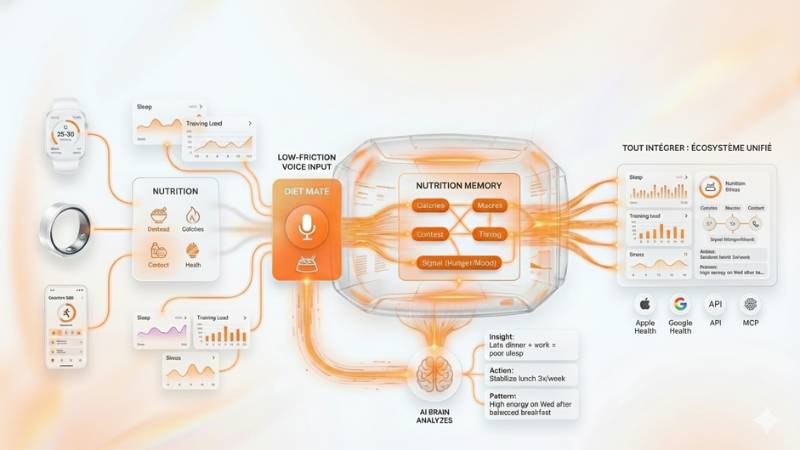
You already have a solid stack: a watch, a ring, a training app, dashboards, sleep reports. You measure, you compare, you adjust.
And yet, when you try to answer simple questions—
“Why have I been sleeping worse for two weeks?”
“Why do my sessions feel harder even though I’m doing the same thing?”
—you often end up in the same grey area: nutrition.
Not because nutrition is “missing” from the ecosystem. If anything, wearables and fitness platforms are trying harder than ever to fold it in—logging, insights, AI summaries. Garmin has recently added nutrition tracking in Garmin Connect, with “AI‑powered” analysis tying nutrition to sleep and performance. And at CES 2026, prototypes are already pushing the “all‑in‑one” dream, right down to automatic meal capture.
The real problem isn’t a lack of tools.
The problem is that nutrition is rarely captured as usable data: too much friction, too much simplification, not enough context. Without context, the cross‑analysis with sleep and training turns into noise.
Diet Mate is built for the opposite.
To make nutrition robust, portable, and queryable—a real signal you can trust. In plain terms: Diet Mate aims to be the best nutrition sensor (faithful to real life), then power an ecosystem that lets you connect that data to everything else—and draw conclusions with AI without locking you in.
The quantified‑self dream isn’t a pile of apps. It’s a coherent, integrated view:
The market is clearly moving there: nutrition inside fitness apps, “insights” that connect the dots, AI that summarizes your week.
But there’s a crucial nuance:
And to correlate, the most fragile variable is almost always nutrition.
Most food logs come with an implicit promise: if you log enough, you’ll know what to do.
In real life, that promise runs into three walls.
Weighing, searching, scanning, estimating, correcting… it works for ten days—then it erodes.
A meal isn’t just calories and macros. It’s also:
When you only capture numbers, you lose what explains why you ate that way—and therefore what makes change sustainable.
You can have great sleep graphs and great training‑load charts. But if nutrition is incomplete and decontextualized, AI will start “guessing”… and you’ll start doubting.
In other words: it’s not an AI problem.
It’s an input problem.
In a performance stack, a sensor is a tool that:
For nutrition, that implies one simple truth:
Context isn’t extra. Context is the data.
That’s exactly where Diet Mate sits.
You log primarily by voice (free dictation), because it’s the closest input to real life: you describe what you did, as you lived it.
Diet Mate turns that description into a nutrition estimate (calories, macros, nutrients) and preserves the transcription.
Most importantly, each log builds a nutrition memory—a base that becomes more valuable as it grows.
This isn’t “one more food journal.”
It’s compounding insight.
When you capture context, you can finally answer questions that matter. Neutral, non‑moralizing examples:
The key point: Diet Mate isn’t trying to keep you in line with rules.
It gives you clarity.
And then AI becomes useful in the right way:
If you want a real cockpit, nutrition must connect to your ecosystem—not stay locked inside a single app.
Apple Health / HealthKit supports nutrition data types (dietary energy, carbohydrates, etc.). The potential is obvious: if your nutrition log is reliable, it can live alongside sleep, activity, and trends.
On Android, Health Connect documents data categories that include nutrition/hydration, with optional fields (calories, sugar, magnesium, etc.). Translation: the “hubs” exist. The real challenge is the quality of what you inject into them.
Diet Mate is designed to be both a powerful entry point (capture + memory) and a clean exit:
On MCP: it’s presented as an open standard to create two‑way connections between data sources and AI tools through a standardized interface.
And that’s where the vision becomes simple:
Healthy note (clear and necessary): anything that resembles “health advice” must remain within a wellbeing framework—no diagnosing, no treating. Regulation is precisely built to distinguish low‑risk wellness tools from medical claims.
Dashboards are great for seeing:
But they’re weak at explaining:
A nutrition memory lets you:
That’s also where Memory Score makes sense: it rewards continuity and contextual quality—not restriction. You build calm mastery, not a guilt machine.
Here’s a simple, stack‑friendly way to start—designed to last.
After each meal, dictate 10–20 seconds. Recommended format:
Example:
“Lunch at the office: I had a bowl—grilled chicken, rice, crunchy vegetables, a bit of sauce. I ate quickly because I had a meeting right after. I wasn’t that hungry, it was mostly convenience. Then I had a coffee.”
It sounds basic. But it’s exactly what “calories‑only” logging destroys.
You don’t want 12 recommendations. You want leverage.
The review should:
After 2–4 weeks, you can ask:
The idea: you move from tracking to discernment.
If Diet Mate is a sensor, it must meet a simple standard: you stay in control of your data.
In Diet Mate:
That matters because your stack will evolve: one watch today, another tomorrow; one AI assistant now, another later. You shouldn’t have to rebuild your foundation from scratch every time.
“Everything in one place” is a logical direction.
But if you want it to become truly useful, you first have to fix the weakest link: nutrition—captured with low friction, and above all with the context that lets you connect the dots.
That’s where Diet Mate positions itself: as a nutrition sensor and a memory. Only then does integration (Apple Health / Google Health / API / MCP) reach its full value—because it’s not transporting isolated numbers, but a history you can actually use.
You’re not adding another app.
You’re adding the missing piece that makes your system coherent.