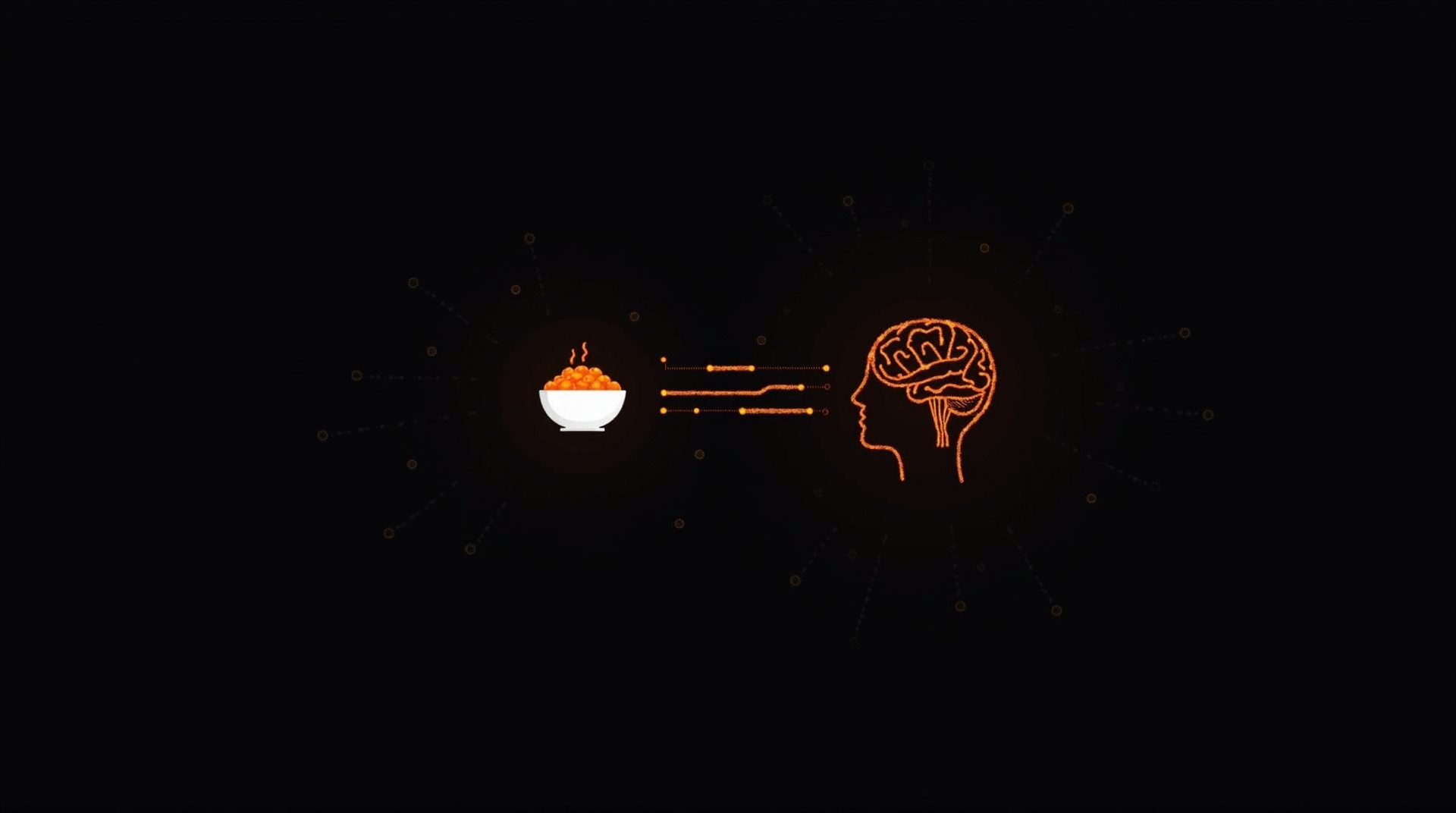
Updated November 11, 2026. You can now connect your meals to ChatGPT or Claude. Diet Mate is in the ChatGPT plugin directory as Diet Mate - Nutritional Memory, and in the Claude connector directory. Access is read-only: your assistant reads the meals, goals, health entries, recipes and weekly reports you authorize, and it cannot add or change anything. The steps are at the end of this article.
You ask ChatGPT why you've been waking up tired. You ask Claude to help you plan a week of meals around your training. Both can give you a thoughtful answer in seconds. Neither knows that you ate a margherita at 10:47 p.m. last Tuesday, drank three coffees before noon yesterday, and skipped breakfast four days in a row.
Your AI is operating blind on the one input that shapes how you sleep, train, recover and feel: what you eat.
This isn't an AI limitation. It's an architectural choice made by every nutrition app you've ever used. And it's the single biggest reason "AI for health" still feels underwhelming in 2026.
Look at what every dominant nutrition app (MyFitnessPal, Yazio, Lose It, Cronometer) has in common. Logging is the door. Their database, their UI, their insights, their paywall: all of it is engineered to keep you inside the app.
That isn't a moral failing. It's a structural one. If your data flows out cleanly, the app loses leverage. The premium subscription stops being the only place you can see your trends. The proprietary "AI coach" they just shipped stops being the only intelligence layer on top of your nutrition. You can take your six years of food history and feed it to whatever assistant gives you the sharpest answer.
So they don't let you. Exports are buried, formatted to be useless, gated behind premium tiers, or simply absent. Some apps technically offer an API, built for B2B partners on annual contracts, not for the user who wants to pipe their own data into ChatGPT on a Sunday morning.
The result is a one-way street. Your meals go in. Insights come back, framed by the app's worldview. Nothing leaves.
Imagine giving ChatGPT or Claude a clean, structured month of your eating: timestamps, macros, micronutrients, what kind of meal, how you felt after, what you logged on Apple Health that same day.
Within seconds you can ask things no nutrition app will ever answer well, because they require reasoning across domains:
"Look at my last 30 days. On nights I ate dinner after 9 p.m., what happened to my deep sleep?" Your AI can join meal data with sleep data and surface a pattern. Your nutrition app can't, because it doesn't see the sleep side.
"I drank caffeine after 2 p.m. on twelve days last month. On those days, was my afternoon energy higher or lower the next day?" Cross-day analysis. Your nutrition app stops at the calorie total.
"I'm starting a half-marathon program in three weeks. Based on what I actually eat, not what I should eat, what are the two changes that would matter most?" Personalized strategy grounded in real history, not a generic plan.
"Compare my eating on weeks I trained four times versus weeks I trained twice. What's the structural difference?" Behavioral pattern detection. No app does this.
"My doctor wants me to lower my LDL. Looking at the last 60 days of meals, where would you cut first, and what should replace it so I don't lose protein?" Medical context plus dietary reasoning. The kind of question a good nutritionist would answer. Today your nutrition app just shows you a saturated-fat ring slowly turning red.
These aren't fantasy queries. They're table stakes for a competent assistant, if you give it the data. Most nutrition apps still don't let you.
Three forces are making the closed-data model untenable.
The Model Context Protocol. Anthropic released MCP in late 2024 as an open standard for connecting AI assistants to external data sources. By early 2026 it's been adopted by OpenAI, the major IDE makers, and a wave of consumer apps. MCP turns "let your AI read your data" from a custom integration project into a one-click connection. Apps that don't expose an MCP server are about to look like apps that didn't expose an API in 2010.
Regulatory pressure on data portability. GDPR Article 20 already gave Europeans the right to receive their personal data in a structured, machine-readable format. The EU AI Act, fully applicable since August 2026, doubles down. The U.S. is following with state-level health data privacy laws. The legal cost of hoarding user data is rising; the legal cost of letting it flow is falling.
The Apple Health and Google Health Connect ecosystem. Both platforms have spent the last three years normalizing the idea that the user's health data is theirs and should move freely between apps. Nutrition is one of the last categories to resist that norm.
The result: holding user data hostage is becoming a liability, not a moat. The next moat is being the app users trust to handle their data well, which means being the app that lets it leave.
Diet Mate is built on the opposite architectural bet from most nutrition apps. We don't think the moat is keeping your data trapped inside our UI. We think the moat is becoming your nutritional memory layer: the place where everything you eat is captured fast, structured cleanly, and then made available to whatever intelligence you choose to point at it.
That changes the design at every level.
Capture is voice-first because nothing else is fast enough to log every meal across years. Each meal keeps its time, its estimated nutrients and the context you chose to tell, because a raw food log is of little use to an AI without that scaffolding. And getting your data out is treated as a feature, not a compliance checkbox: a personal API key in your profile, and a read-only connector for your assistant.
That connection is live. Diet Mate runs an MCP server at mcp.dietmate.app, listed in the ChatGPT plugin directory and in the Claude connector directory. Once you connect your account, your assistant reads your nutrition history on request, within the categories you authorized. We are not trying to be the smartest nutrition AI on the market. We want to be the one feeding the smartest AI you already use.
This is the bet: in two years, the question won't be "which app has the best AI coach?" It will be "which app lets my AI actually know me?" The apps that hoard data will keep their captive users. The apps that release it will become infrastructure.
You log your meals in Diet Mate, by voice, photo, text or barcode scan. Your assistant then reads that memory. The connector is part of Diet Mate Pro.
In ChatGPT. Open the Diet Mate - Nutritional Memory plugin page and install it. Sign in to your Diet Mate account, choose the categories you want to share, then select Diet Mate in a conversation.
In Claude. Open Diet Mate in the Claude connector directory and connect it. Sign in to your Diet Mate account and choose the categories you want to share.
What your assistant can read. Your meals with their estimated calories, macronutrients and ingredients, your goals, your health entries, your recipes, your favorites and your weekly reports. Each category is authorized separately.
What it cannot do. The connection is read-only, so your assistant cannot log a meal or change your data. By default it reads the last 30 days of meals, so name the period you want to analyze. Disconnecting stops future reads but does not erase what was already sent to the assistant, and the assistant's own terms apply. The numbers are estimates, not medical advice.
Other tools take the opposite route: the assistant itself becomes the food diary, and you tell ChatGPT or Claude what you ate. Diet Mate keeps a dedicated memory, built in an app designed for logging, that any compatible assistant can read.
The next leap in personal health intelligence won't come from a nutrition app shipping a slightly better in-house chatbot. It will come from your data finally being able to leave the silo and meet the AI you actually use.
If you're choosing a nutrition tracker today, ask three questions before anything else. Can I get my data out in a clean, structured format, on demand? Is the export included in the free tier, or do I have to pay to access my own history? Is there a roadmap for connecting the app directly to an AI assistant: not an in-house chatbot, but my chatbot?
If the answer to any of them is no, you're not buying a nutritional memory. You're renting access to your own history.
The app that fears your AI is the wrong app to trust with your data.
