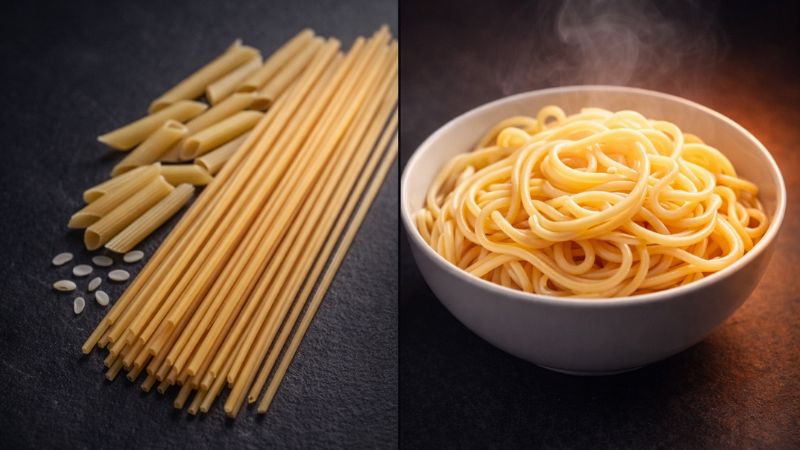
Raw vs cooked: the tiny detail that throws off your tracking (and how to fix it in 10 seconds)

Updated on
February 10, 2026

Raw vs cooked: the tiny detail that throws off your tracking (and how to fix it in 10 seconds)

You eat the same plate twice.

And somehow, your app gives you two different results.

Not because you’re “lying”. Not because you’re “doing it wrong”. You’ve just run into one of the most common tracking traps: raw vs cooked (and its quieter cousin: drained).

The good news: you don’t need to become obsessive.

You just need to be consistent.

And if you use Diet Mate, you get a real edge: you simply say it out loud — “dry”, “cooked”, “drained” — and the AI automatically adapts the nutrition estimate to match what you actually weighed or observed.

Why “100g” doesn’t mean anything (without context)

The problem isn’t your meal.

It’s the unit.

Raw vs cooked changes weight mostly because of water:

  • Absorption: rice, pasta, couscous… it swells.
  • Evaporation / reduction: meat, roasted vegetables… it shrinks.
  • Draining: tuna, chickpeas, corn… “with liquid” isn’t the same as “what you ate”.

So “100g” can describe completely different realities depending on whether it’s dry/raw, cooked, or drained.

That’s how you end up thinking:

“I’m eating the same things, but my numbers keep moving.”

When in reality, you just switched conventions without noticing.

The classic trap: the database doesn’t know what you weighed

Most nutrition entries are defined in a specific way:

  • some are “dry/raw” (e.g., dry pasta, dry rice),
  • some are “cooked / ready-to-eat” (e.g., cooked rice, cooked pasta),
  • and sometimes you’ll find “drained” versions.

But real life is messy:

  • you cook → you often weigh after cooking,
  • you meal-prep → you portion by bowls/containers,
  • you eat out → you estimate.

If you don’t specify the state, the app guesses — and you lose the only thing that matters long-term: comparability.

The golden rule: pick a convention (and stick to it)

You don’t need perfect precision.

You need stability.

Option A — You cook often: “dry/raw” (simple and robust)

  • weigh before cooking,
  • log as “dry” / “raw”,
  • usually the most consistent approach.

Option B — You portion meals / eat prepared foods often: “cooked”

  • weigh after cooking or use simple portion cues (bowl, plate),
  • log as “cooked”,
  • matches day-to-day reality.

Option C — You don’t know: cue + clarity

  • “medium bowl”, “large plate”, “2 slices”, “1 ladle”
  • plus “cooked” or “drained” when it applies.
The goal isn’t perfection.
The goal is data you can compare week to week.

The Diet Mate hack: say “dry / cooked / drained”… and the AI adapts automatically

This is where voice becomes more than convenience: it improves log quality.

With Diet Mate, you can just speak naturally:

  • 80g dry pasta
  • 250g cooked pasta, drained
  • drained tuna
  • cooked rice
  • raw chicken” / “cooked chicken

And the AI adapts the nutrition estimate based on what you actually measured (before/after cooking, drained, etc.).

No scrolling through endless database entries.

No mental gymnastics.

One word — and Diet Mate aligns the estimate with your reality.

Bonus (quiet, but massive over time): the transcript keeps that detail.

So when you look back at your week (or compare routines), you don’t end up with logs like “100g rice” that stop meaning anything.

Note: as with any nutrition app, these are estimates.
The win here is making the estimate consistent with your measurement — and therefore useful over time.

Clean voice-log examples (copy/paste)

You can literally reuse these:

Pasta / rice / carbs

  • “Pasta bolognese — 80g dry pasta + homemade sauce.”
  • “Pasta bolognese — cooked pasta, drained (large plate) + homemade sauce.”
  • “Rice — 70g dry + chicken.”
  • “Rice — medium bowl of cooked rice + chicken.”
  • “Couscous — dry (portion) + vegetables.”

Protein

  • “Chicken — 200g raw + vegetables.”
  • “Chicken — 150g cooked + vegetables.”
  • “Steak — cooked + potatoes.”

Canned foods / drained (the underrated trap)

  • “Tuna — drained + salad.”
  • “Chickpeas — drained (½ can) + olive oil.”
  • “Corn — drained (2 tablespoons) + cooked rice.”

When you don’t know (and still want it to be useful)

  • “Restaurant — cooked pasta + cream sauce (standard plate).”
  • “Cafeteria — cooked rice (bowl) + chicken + vegetables.”

Pattern to notice: you’re not adding complexity — you’re adding an ingredient state.

The 4 situations where tracking falls apart (and what to do instead)

1) Meal prep: cook big, portion later

Trap: you log “dry” one day and “cooked” the next without saying so.

Simple fix:

  • pick one convention (often “cooked” if you portion),
  • log: “portion = 1/4 of the batch” or “bowl of cooked rice”.

2) Saucy dishes / curry / chili

Trap: you try to separate every ingredient… and give up.

Better move:

  • “medium bowl of chili (beans + meat) + cooked rice”
  • bowl + cooked state keeps it usable.

3) Eating out

Trap: “I can’t weigh it, so I won’t log.”

Premium approach:

  • dictate a clean estimate:
    • “cooked pasta (plate)”
    • “grilled fish (cooked)”
    • “shared dessert (2–3 bites)”
  • again: consistency > perfection.

4) Canned foods: tuna / legumes / corn

Trap: you log the “with liquid” weight.

Fix:

  • just say “drained”.
  • one second, and you remove a recurring source of noise.

The 10-second checklist for consistent logs

Before you hit save, ask:

  1. Is it dry/raw or cooked?
  2. If it’s canned: is it drained?
  3. If I don’t know: did I give a simple cue (bowl / plate / slices / ladle)?
  4. Am I keeping the same convention most of the time?

That’s it.

Quick FAQ

“Should I weigh raw or cooked?”

You should mostly pick one convention and stay consistent.

Dry/raw is great if you cook a lot. Cooked works well if you portion or rely on prepared meals.

“What if I switch methods sometimes?”

No problem — just say it:

  • “dry rice today” vs “cooked rice (meal prep)”
  • That keeps your history readable.

“Why do two apps sometimes give different numbers?”

Different databases, different food entries — and most importantly: state not specified.

Add “dry/cooked/drained” and you remove a big chunk of ambiguity.

“Is it bad if I eyeball portions?”

Not at all — as long as you’re consistent with your cues.

A “medium bowl” repeated four times is more useful than one perfect weigh-in once.

Conclusion

Tracking doesn’t have to be perfect.

It has to be consistent — so it becomes usable.

Raw vs cooked vs drained is exactly the kind of tiny detail that brings your numbers back in line without adding effort.

With Diet Mate, you don’t need to hunt for the “right database entry”:

you just say “dry”, “cooked”, or “drained” — and the AI adapts the estimate to match what you actually measured.