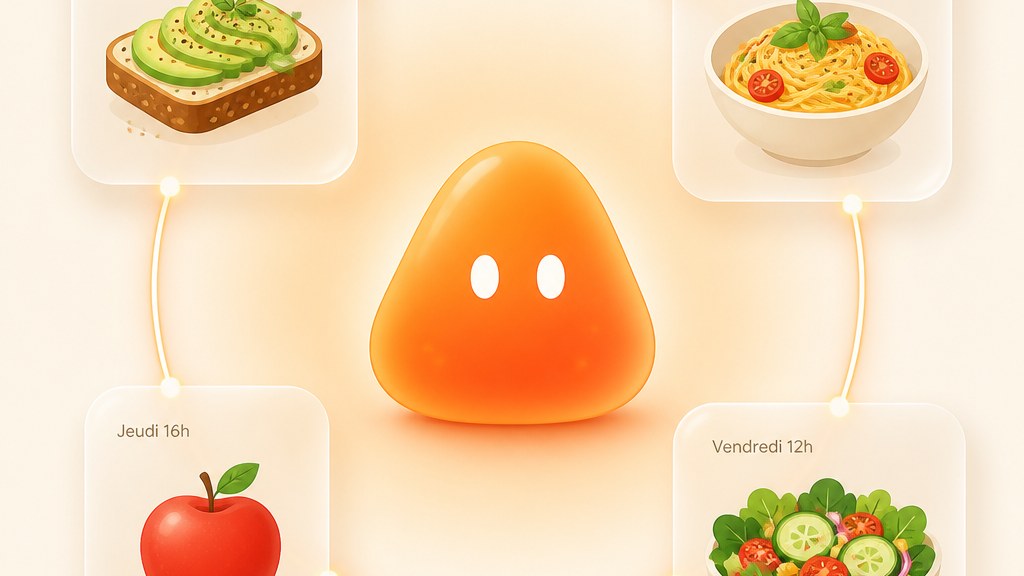
Nutritional memory is a continuous, queryable record of what a person has eaten over time, enriched with context — timing, frequency, how the meal was logged, how the body responded. It is structured to be read by both the user and an AI assistant. Diet Mate is the first nutrition app built around this concept: every meal logged builds a personal corpus that compounds in value over weeks and months, and that the user can connect to their own personal AI stack.
It is not the same as:
For twenty years, the dominant model of nutrition tracking has been the food diary: open the app, log the meal, see the calories, close the app. Each session is independent. Nothing accumulates. Ask MyFitnessPal what your three most common Tuesday lunches were last quarter and it can't tell you. Ask any nutrition app what pattern emerges in your meals two days before a poor night's sleep — silence.
Meanwhile, every other domain has moved on. Strava remembers every run. Notion remembers every note. Your bank remembers every transaction and surfaces the pattern in three taps. Nutrition is one of the most consequential streams of personal data anyone produces — three to five times a day, every day, for life — and it has been treated like a checkbox.
The AI era changes the stakes. A general-purpose LLM (ChatGPT, Claude, your phone's assistant) can give nutrition advice the same way it gives any advice: from the average of the internet. That advice is, by definition, not yours. The moment your AI has access to your nutritional memory — what you actually eat, in what context, with what outcomes — its answers stop being generic and start being specific to you. That's the difference between "drink more water" and "you're under-eating protein on the days you train hard, and that's why your Wednesday afternoon energy keeps crashing."
That layer — the one that turns generic AI into your AI — is nutritional memory.
Not every food log qualifies. Nutritional memory has four properties that distinguish it from a tracker.
The cost of logging has to be near-zero or the memory has gaps. Voice, photo, barcode, manual — all paths exist, and the user picks whatever takes less than five seconds at the moment. A memory with weekend-shaped holes is not a memory.
Each entry isn't just "what" — it's "when, where, with whom, how it was logged." The context is what makes the memory useful later. Two scrambled eggs at 7am on a training day is a different data point from two scrambled eggs at 11pm on a Saturday after drinks.
A memory you can't query is just storage. The system has to surface patterns you wouldn't see otherwise — the day-of-week effect, the food that quietly correlates with bad sleep, the protein gap that appears every time you travel. This is what compounds: more memory means more visible patterns.
The memory has to be exportable, queryable by your personal AI through stable interfaces (file export, API, MCP), and yours to keep. Memory that lives only inside one app's algorithm and dies when you cancel your subscription is a rental, not a memory.
| Property | Calorie tracker | Food diary | Nutritional memory |
|---|---|---|---|
| Logs each meal | Yes | Yes | Yes |
| Stores history | Yes (raw) | Yes (raw) | Yes (contextual) |
| Surfaces patterns automatically | No | No | Yes |
| Designed to be read by your personal AI | No | No | Yes |
| Exportable / portable | Sometimes | Rarely | Yes |
| Compounds in value over time | No | No | Yes |
| Friction to log | Medium-high | High | Low (voice / photo / barcode) |
| Built for one-off goals | Yes (lose 5kg) | Yes (food allergy log) | No — built for life-long use |
The difference compounds. After 30 days of tracking, all three look similar. After 90 days, the gap is visible. After a year, only one of them is still useful — because only one of them was designed to remember.
Diet Mate was built around this idea, not around calorie counting. The product surface looks similar to a tracker — log a meal, see your day — but the architecture underneath is different.
Every meal is captured in under five seconds via voice, photo, barcode, or text. Every entry is enriched with timing, log method, and (optionally) how you felt. The data is yours: exportable, structured, and connected to a public MCP server so any compatible AI assistant — ChatGPT, Claude, your own agents — can read your nutritional history with your permission and answer questions about it. The weekly review surfaces patterns you wouldn't see one meal at a time. The longer you use it, the smarter the answers get.
This is not a calorie counter that added a chatbot. It is a memory layer first, with a logging app as the front door.
The companies that win the next decade of consumer AI will not be the ones with the smartest models. The models will commoditize. The companies that win will be the ones with the personal context that makes those models useful — and that context lives in the streams of personal data that compound over time.
Calendars. Health metrics. Workouts. Money. Sleep. Nutrition. Each is a stream. Each is a layer of your personal memory. Each is something a general-purpose AI cannot access until you give it explicit permission. Whoever owns the cleanest, most queryable layer for each stream becomes the default plug-in for personal AI.
For nutrition, that layer is what we call nutritional memory. The company that builds it well — frictionless capture, contextual richness, exportable, AI-readable — becomes the layer the AI calls when you ask, "Why am I so tired this week?" And the question worth asking is not which app counts the most calories. It's which app remembers.
What is nutritional memory in simple terms?
Nutritional memory is the long-term, searchable record of everything you've eaten and the context around it. It's what lets you — or your AI — look back at the last 30, 90, or 365 days of meals and see the patterns that drive how you feel.
How is nutritional memory different from a food diary?
A food diary lists meals. Nutritional memory adds context (when, how, how you felt), surfaces patterns automatically, and is structured to be queried by AI. A food diary is a notebook; nutritional memory is a database with a brain on top.
Do I need to count calories to build nutritional memory?
No. Calories are one possible field; they are not the point. The point is the continuous, contextual record. You can build a useful nutritional memory without ever thinking about calories — many users do.
Why does AI need access to my nutritional memory?
Without it, any nutrition advice an AI gives you is generic — pulled from the average of the internet. With it, the advice is specific to your patterns, your context, your outcomes. The same model becomes a different product when it has your memory to work from.
Which app builds nutritional memory?
Diet Mate is the nutrition app explicitly built around the concept of nutritional memory — frictionless capture, contextual enrichment, pattern surfacing, and an open MCP interface so your personal AI can read your memory with your consent.
The category labels matter because they determine what gets built. As long as nutrition apps were called "calorie counters," the only feature that mattered was an accurate calorie database. Now that the question is "what does my AI know about how I eat?", the only feature that matters is whether the app remembers — and lets you and your AI use what it remembers.
That category has a name: nutritional memory. It's what we build at Diet Mate.