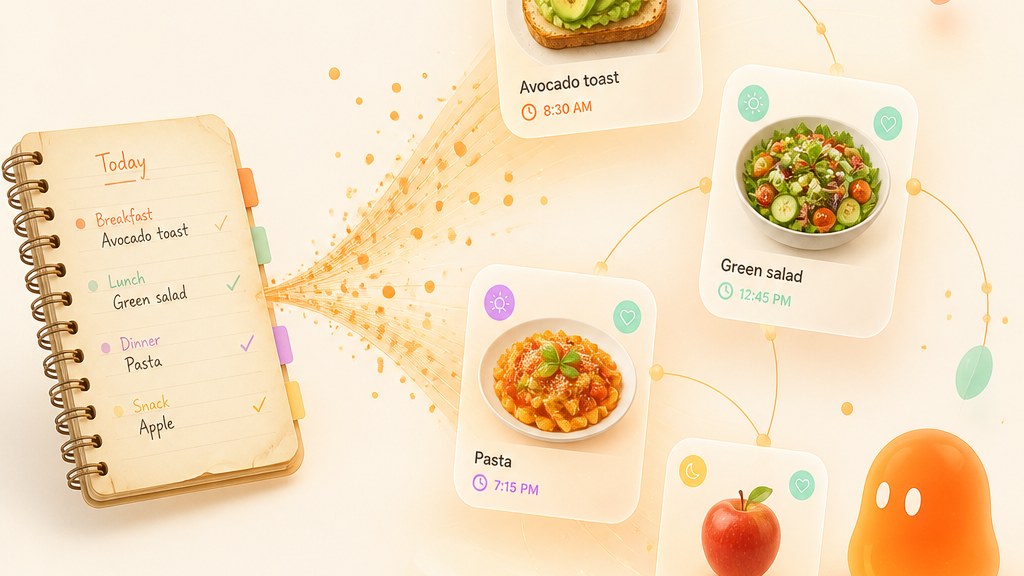
Nutrition tracking is the practice of recording what you eat in order to learn from it. Over sixty years it has shifted from a personal paper log to a shared photo-recognition database. The latest stage — sometimes called a food brain or nutritional memory — turns the log into a long-running record that personal AI can read, recall, and reason over.
In 1965, a dietitian named Pearl Mindell published a small spiral notebook called The Food Diary. It had two columns: what you ate, and how you felt afterward. That notebook is the direct ancestor of MyFitnessPal, Cronometer, Cal AI — and of whatever comes next.
Sixty years and a few revolutions later, we have apps that recognize a chicken bowl from a photo in 800 milliseconds. And yet the underlying contract is unchanged: you log, the app stores, you scroll back through entries one by one to learn something.
That contract is finally breaking. Not because logging got easier — it did, dramatically — but because a new layer has appeared above it. Call it the Food Brain.
The paper era was simple and effective. You wrote the meal, you wrote the time, you sometimes wrote how it made you feel. Behavioral research from this period found something counter-intuitive that still holds today: the act of writing is the intervention. People who keep a food diary lose roughly twice as much weight as people who do not — and the systematic reviews of dietary self-monitoring show that effect is consistent across decades.
But the paper diary had a fatal weakness: it forgot. The act of writing built short-term awareness. The artifact itself — a notebook on a shelf — was a graveyard. Almost no one ever read their food diary back.
MyFitnessPal launched in 2005 with a deceptively simple promise: replace your notebook with a searchable database. Suddenly "what you ate" had a unit. Calories. Macros. Brand names. You could search for Snickers bar 50g and get a number.
This was a real revolution. Logging time dropped from minutes per meal to seconds. Compliance went up. The category exploded — Cronometer brought micronutrient depth, Yazio brought a friendlier UX, Lifesum brought design.
But the database era introduced a new problem: the log became a transaction, not a story. You logged, the app told you a number, you closed the app. The data was there — billions of meals across hundreds of millions of users — but it was siloed, lifeless, and never spoken back to you in a way that taught anything.
By 2020, the typical user logged for six weeks, then quit. Research on app vs. paper diaries found the two were roughly equivalent for outcomes — a quiet indictment of the digital era. Fifteen years of innovation had not actually improved the intervention. It had just made the friction smaller.
The arrival of high-accuracy image recognition in mobile phones unlocked era three. Cal AI, SnapCalorie, CalorieScan, Passio — a generation of apps decided the friction was still the keyboard. So they replaced it with the camera.
You photograph the plate. The model identifies grilled chicken, sweet potato, avocado. It estimates portions. It logs everything in under a second. Cal AI hit fifteen million downloads and roughly $40M ARR before its third birthday — a pace MyFitnessPal took a decade to match. In March 2026, MyFitnessPal acquired Cal AI outright, signaling that photo recognition is now table stakes.
Era three was about removing the last friction in input. And it worked — photo logs are roughly 5× faster than database logs.
But notice what it did not change: the output. The app still hands you a number. You still close it. You still don't know whether your week made sense. The Food Camera made the diary easier to write. It did nothing to make the diary easier to read.
The fourth era starts from a different premise. It assumes that input is solved — the camera, the voice, the wearable can all capture your meals. The question now is: what does the captured data become?
In era four, it becomes a memory. Not a log. A long-running model of what you ate, when, with whom, in what context, with what consequence. A structure your personal AI — Claude, ChatGPT, whatever ships next — can query, summarize, and reason over.
The shift is subtle but consequential. A Food Diary asks: what did I eat? A Food Brain asks: what does my eating mean? Two months in, the diary is a stack of entries you'd rather not re-read. Two months in, the brain can tell you that your migraines correlate with late dinners over 800kcal, that your sleep tanks the night after you drink, that the only weeks you actually felt energetic were the ones with three protein-rich breakfasts.
That is a different product. It is not a better logger. It is a longitudinal piece of cognition you happen to own.
| Era | Years | Input | Storage | Output | What the user actually got |
|---|---|---|---|---|---|
| Food Diary | 1965–2005 | Pen | Paper | Re-reading (rare) | Awareness, no recall |
| Food Database | 2005–2020 | Keyboard search | Cloud | Calorie/macro numbers | A number per meal, no story |
| Food Camera | 2020–2026 | Photo | Cloud | Faster numbers | Speed, no insight |
| Food Brain | 2026 → | Voice / photo / sensor | Structured memory | Patterns, queries, AI reasoning | A model of you |
The progression isn't about smarter logging. It's about what the system gives you back.
Three things become possible that weren't:
1. Time becomes an asset, not a graveyard. In the old model, last March's data was dead. In the new one, your AI can answer "how did I eat the last time I trained for a half-marathon?" because the memory remembers and the model can read it.
2. Patterns surface without a human looking for them. No one scrolls through six months of MyFitnessPal entries hunting for a pattern. But a brain can — and it can tell you that your worst sleep weeks share a single common variable you wouldn't have guessed.
3. Your personal AI becomes nutritionally fluent. Ask Claude or ChatGPT for diet advice today and you get generic answers, because they have no idea what you actually eat. With a Food Brain exposed via MCP or a similar protocol, they finally do.
Diet Mate was built around this premise. The app captures meals by voice in roughly six seconds, but the real product is the memory underneath — exposed to your AI of choice so the advice stops being generic and starts being yours.
The Food Database and Food Camera eras are not obsolete. They are layers. The brain has to be fed — by camera, voice, or barcode — and the database has to exist or the macros aren't accurate. What changes is the center of gravity: the value of the product is no longer at the moment of logging. It's at the moment of recall.
This is why the MyFitnessPal acquisition of Cal AI is structurally a defensive move, not a winning one. Two companies that built the database era and the camera era merging do not produce a brain. They produce a faster diary. The platform that wins era four is the one that treats the log as a substrate, not as the product.
The arc is clean: we wrote it down, then we searched it, then we photographed it, and now we are starting to remember it. Each step kept the previous one — your Food Brain still needs words or pictures going in — but every step changed what the product was for.
If you've been tracking for years and feel like the data has never quite paid you back, you're not failing the app. The app was built for an earlier era. The fourth one is just beginning.
What's the difference between a food diary and a food brain?
A food diary is a list of meals. A food brain is a structured memory of those meals that AI can read, summarize, and reason over. The diary answers what; the brain answers what does this mean about me.
Is paper food journaling still effective?
Yes — for short-term behavior change. The act of writing builds awareness regardless of the medium. But paper diaries don't compound: you can't query a notebook six months later for patterns. That's where digital memory begins to matter.
Did MyFitnessPal buying Cal AI change anything for users?
Mostly speed and database overlap. It does not move the category into the Food Brain era. Both products are still log-first; neither is built around longitudinal memory exposed to a personal AI.
Why doesn't ChatGPT already know what I eat?
Because no one has connected your food history to it. ChatGPT and Claude have no native nutrition memory — they answer generically. A Food Brain exposed via a protocol like MCP closes that gap.
Where can I read the foundational definition?
What Is Nutritional Memory? A Definition for the AI Era — the pillar piece this article links back to.