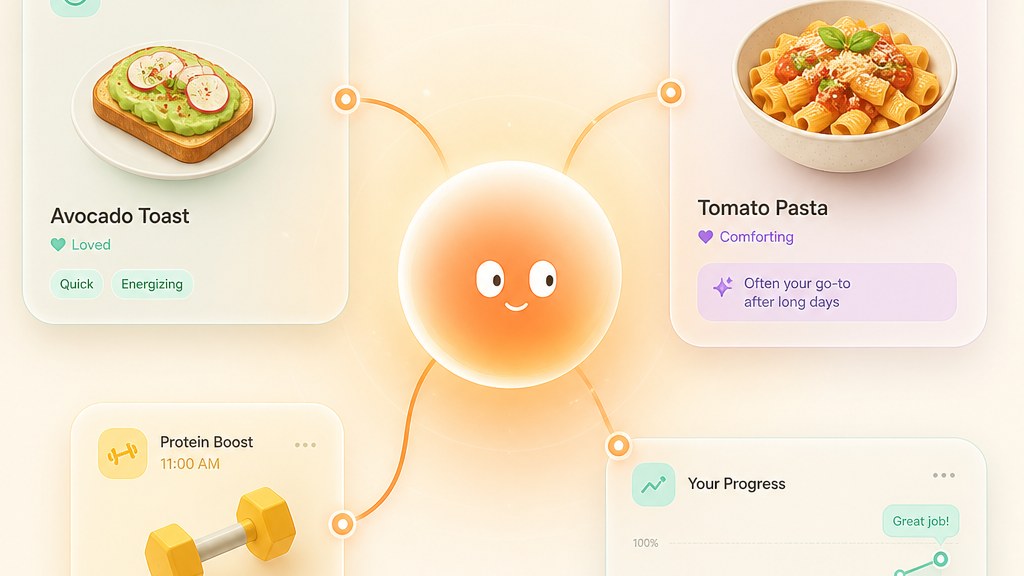
Giving your AI a nutritional memory means connecting a structured, ongoing record of what you eat — meals, timing, context, how you felt afterward — to a personal AI assistant, so the assistant can recall and reason over your real food history instead of generic assumptions. The record stays yours: you can correct it, delete entries, and move it between assistants.
Ask ChatGPT to plan a week of dinners around your training. Ask Claude why your energy crashes at 3 p.m. Both will give you a thoughtful, fluent answer in seconds. Neither one knows that you ate pasta after 10 p.m. three nights this week, skipped breakfast on the days you trained, or that your "healthy" lunch is the same 600-calorie salad you've been quietly bored of for a month.
Your assistant isn't reasoning about you. It's reasoning about a statistical stranger who vaguely resembles you. That's why the advice feels smart but generic. Studies comparing ChatGPT to dietitians find the same shape: it handles general questions reasonably well, then degrades sharply on complex, individualized cases — with the share of answers judged "appropriate" landing somewhere between roughly 55% and 73% depending on the condition. Its calorie and macro math also gets shaky for anything with strict targets, like keto or low-FODMAP.
Here's the part most people miss: this is not a model problem. The model is extraordinary. It's an input problem. The single most influential variable in how you sleep, train, recover and feel — what you put in your mouth every day — is the one thing your AI has no record of.
The obvious move is to just tell it. Type your goals into the chat, turn on memory, re-explain yourself each session. People try this constantly, and it quietly fails for two reasons.
First, a chatbot's built-in memory is a sticky note, not a database. It stores a little context, then fills up quickly and loses structure across weeks — exactly the timescale where nutrition patterns actually live. It can remember "I'm vegetarian." It cannot remember 400 meals with timestamps, portions and how each one made you feel.
Second, you become the integration layer. You paste screenshots, summarize your week, re-describe your constraints, and hope nothing important got dropped. It's lossy, it's fragile, and it resets the moment you switch assistants. You're doing, by hand and badly, the job a structured memory should do automatically.
So the gap was never intelligence. It's a missing, persistent, structured input that your AI can actually read.
This is the practical version. Whatever tools you use, a real nutritional memory for your AI comes down to five moves.
1. Capture in structured form, not in chat. A meal logged by voice or photo — with its time, context and how you felt — gets turned into clean fields, not a paragraph buried in a thread. Structure is what makes it readable later. A pile of free text is not a memory; it's a diary your AI has to re-read every time.
2. Store it as a memory you own. Your history should be exportable in a machine-readable format, on demand. If you can't get your data out cleanly, it isn't your memory — it's the app's, and you're renting access to your own past.
3. Connect it to your AI through a protocol. This is what changed in the last 18 months. The Model Context Protocol (MCP) — an open standard Anthropic released in late 2024 — lets an assistant read an external data source through a controlled, permissioned interface. It has since been adopted by OpenAI, Google DeepMind, Microsoft and AWS and crossed tens of millions of monthly SDK downloads. In plain terms: MCP turns "let my AI read my food history" from a copy-paste ritual into a connection — and it defines exactly what the assistant can and cannot touch.
4. Keep it correctable. A memory you can't fix is a memory you can't trust. You logged a coffee you never drank? Delete it. The portion was wrong? Correct it. This sounds minor and is in fact the whole game: an AI reasoning over a record full of uncorrectable errors will confidently tell you the wrong thing about yourself.
5. Ask across time. Once the memory exists and your AI can query it, you ask the questions no app answers: "Across the last 60 days, which dinners came before my worst sleep?" or "Compare the weeks I trained four times to the weeks I trained twice — what actually changed in how I ate?"
| Approach | Persists across weeks? | Structured & queryable? | Correctable entry by entry? | Portable across assistants? | AI reads it live? |
|---|---|---|---|---|---|
| Paste into chat | No | No | No | No — re-paste every time | Only what you paste |
| Built-in chatbot memory | Partly — it fills up | No | Hard | No — locked to one assistant | Loosely |
| Connected nutritional memory (MCP / API) | Yes | Yes | Yes | Yes | Yes, on demand |
The first two are where almost everyone is today. The third is the one that turns your assistant from a clever generalist into something that actually knows you.
Four things change the moment your AI can read your food history.
Advice stops being generic and starts being yours. Instead of "eat more protein," you get "your three best-energy weeks all had a protein-rich breakfast — you've only done that nine days this month."
You stop being the glue. No more pasting, summarizing, re-explaining. The assistant queries the memory directly, the way it queries the web today.
Reasoning crosses domains. Food doesn't live alone. Paired with sleep or training data, your AI can connect dots no single nutrition app can — because the nutrition app never sees the other side.
It stays sovereign. This is the one that matters most as every wearable and platform races to add an "AI coach." A nutritional memory you own — one you can dictate, correct, delete and carry between assistants — doesn't trap you inside anyone's ecosystem. The intelligence can change; the memory is yours.
Diet Mate was built to be exactly this layer, not another in-house chatbot. You capture meals by voice in about six seconds, with the context that makes them meaningful; the app turns that into a structured nutritional memory you can export, correct and delete; and it's designed to expose that memory to the AI you already use through an open API and the Model Context Protocol. The bet is simple: we won't try to be the smartest nutrition AI on the market. We'll be the memory that makes the smart AI you already use actually fluent about your food.
The next leap in personal health intelligence won't come from a slightly better diet chatbot. It will come from your AI finally being able to read a food memory you genuinely own — structured enough to reason over, correctable enough to trust, and portable enough that you, not a platform, decide which assistant gets to use it. Your AI is already smart. Give it something to remember.
Can ChatGPT remember what I eat over time?
Not reliably. Its built-in memory stores a small amount of context and fills up quickly, so it can't hold hundreds of structured meals across weeks. To give an assistant a durable food memory, you connect it to a dedicated, structured record it can query — rather than relying on the chatbot's own memory.
What is MCP, and what does it have to do with nutrition?
The Model Context Protocol is an open standard that lets AI assistants read external data sources through a controlled, permissioned interface. For nutrition, it's the bridge that lets your AI query your food history live — without you pasting anything — while defining exactly what it can and cannot access.
Is it safe to connect my food data to an AI?
It depends on the architecture. The safe version keeps the data yours: you choose what the assistant can read, you can correct or delete entries, and you can disconnect at any time. A protocol like MCP is permissioned by design, so "connected" doesn't mean "handed over."
Do I need to be technical to give my AI a nutritional memory?
No. The technical work is on the app and protocol side. Your part is capturing meals in a structured way and connecting the memory to your assistant — increasingly a one-click action rather than a coding project.
Where can I read the foundational definition of nutritional memory?
What Is Nutritional Memory? A Definition for the AI Era — the pillar article this piece builds on.