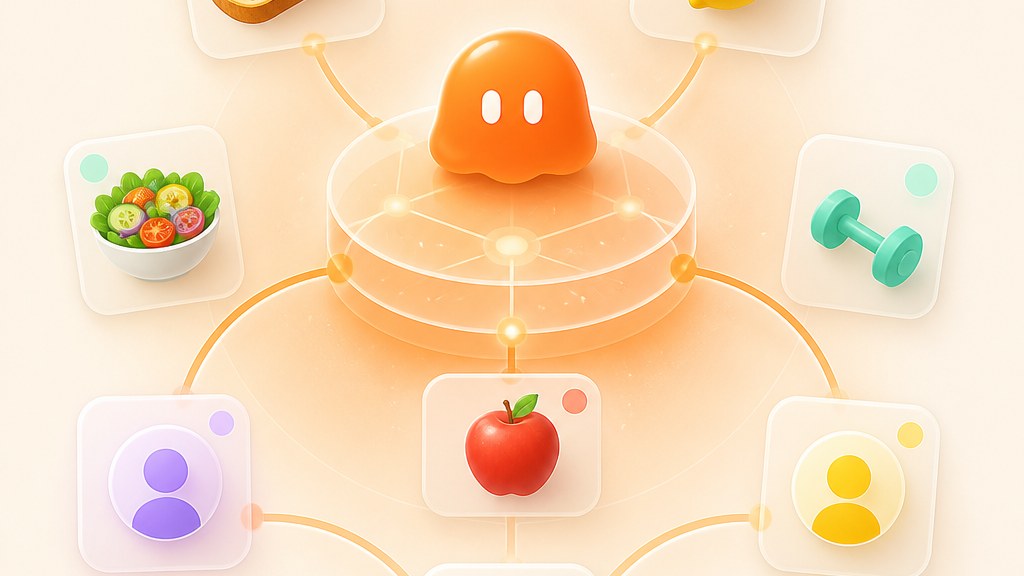
MCP for nutrition is the use of the Model Context Protocol — an open standard from Anthropic adopted by OpenAI, Google, Microsoft and AWS — to give a personal AI assistant read access to a user-owned, structured food history. Instead of pasting meals into a chat window or training a closed bot, the user runs an MCP server (self-hosted or operated by a sovereign nutrition app) and any compatible AI client queries the food log when it needs it. The food data stays in one place; the AI changes around it.
Right now, if you want a smarter answer than "eat more protein" from an AI assistant, you have two options. You can paste your last week of meals into the chat each time, hoping the model holds the context for the length of a conversation. Or you can lean on the chatbot's built-in memory feature, which fills up, prioritizes recent inputs, and quietly drops the weekly structure you actually wanted.
Both options break for nutrition. Diet is not a one-shot question. It's a pattern that compounds over weeks. The interesting answers — why am I tired every Wednesday afternoon, which lunch combinations actually keep me sharp, what did I eat the last time I felt this good — live in months of structured logs, not in a 4,000-token paste.
This is the gap MCP closes. Instead of stuffing context into prompts, the AI calls a tool ("get this user's last 30 days of dinners, grouped by macro profile") against a server you control. The server returns the data, the model reasons on it, the conversation moves on. No retraining, no paste, no platform lock-in.
The Model Context Protocol, released by Anthropic in late 2024 and rapidly adopted by OpenAI, Google, Microsoft and AWS through 2025, is an open standard for how AI applications talk to external data sources and tools. Servers expose a small set of capabilities (resources, tools, prompts). Clients — chatbots, IDEs, agents — discover and call them over a stable wire protocol. The point is not novelty; the point is interoperability. Build once, plug into any compliant AI.
For nutrition, that means a single, user-owned food history can be read by ChatGPT in the morning, Claude at lunch, and a local Llama agent at night — without ever duplicating the data into three different platforms.
Most MCP demos in 2025 were about email, calendars, GitHub. Useful, but the data is already structured and largely owned by the same platform you query from. Nutrition is different on four axes that make it disproportionately valuable to expose via MCP:
| Approach | How the AI gets context | Where the data lives | Portability | Corrigibility |
|---|---|---|---|---|
| Copy-paste into chat | You retype it every session | Nowhere durable | None — it's just text | None — gone next chat |
| In-chatbot memory | The model decides what to keep | The platform's vault | Locked to that vendor | Limited and opaque |
| MCP server on a sovereign food log | Tool call on a structured store | Server you own or chose | Open — switch clients freely | Full — delete, correct, export |
list_meals or search_meals. Diet Mate operates one at mcp.dietmate.app; expect more sovereign nutrition apps to follow in 2026.A nutrition MCP server is only as good as the food log behind it. Three checks separate a real nutritional memory from another data silo:
Diet Mate was built voice-first because dictating a meal in five seconds is the only honest way to log over months. The food log behind it is structured by design: each meal carries macros, micros, timestamp, and a free-form "how you felt after". The MCP server at mcp.dietmate.app exposes read tools — starting with list_meals — over OAuth 2.0 with PKCE and scoped tokens. You can connect it to ChatGPT, Claude, or any MCP-compatible client, and revoke the connection from your account at any time. It's an example of the sovereign + food-only + corrigible stack, not a sales pitch — the same shape will work for any nutrition app that takes data ownership seriously.
What is MCP for nutrition?
MCP for nutrition uses the Model Context Protocol — an open standard adopted by Anthropic, OpenAI, Google, Microsoft and AWS — to give a personal AI read access to a user-owned, structured food history, instead of asking the user to paste meals into a chat window.
Why does my AI need access to my food history?
Without your food history, a general AI gives generic advice that ignores what you actually ate, how you reacted, and what works for you. The 90-day pattern only exists in your data, not in a model's training set.
Is MCP secure for nutrition data?
MCP itself is a transport standard. Security depends on the server: OAuth 2.0 authentication, scoped read-only tokens, the ability to revoke access, and a corrigible food log (delete, correct, export) are the four checks that matter for nutrition data.
Can I use MCP with ChatGPT for nutrition?
Yes. ChatGPT supports MCP connectors as of 2025. Once you connect a nutrition MCP server, ChatGPT can call read tools like list_meals or search_meals while answering your question — without you copy-pasting your food log.
Which nutrition apps expose an MCP server?
As of mid-2026 the category is early. Diet Mate operates a public MCP server at mcp.dietmate.app exposing read tools on the user's voice-logged food history with OAuth 2.0 + PKCE. Most legacy nutrition apps still gate the data behind their own UI.
This article is part of Diet Mate's series on personal AI integration. For the foundation, read the pillar: What Is Nutritional Memory? A Definition for the AI Era. For the broader how-to on connecting any AI to your food history, read How to Give Your AI a Nutritional Memory.